Episode Transcript
[00:00:00] Speaker A: All right, guys, welcome back to the podcast. Today we have Henry with us and he's been on the podcast a couple different times, but when I first met Henry, he was, I believe, in construction. Right.
And now you're full time flying drones, either thermal drones or agricultural drones. Is your lifestyle now? I think so. Right?
[00:00:19] Speaker B: Yep. Pretty.
[00:00:20] Speaker A: Well.
[00:00:20] Speaker B: I still, I still help out with construction here and there. You know, fungicide season, main parts over. My father in law needs some help, so this last three, four days I was helping him with a couple projects, so.
[00:00:30] Speaker A: But that's not your main focus? No, it's not doing construction anymore.
[00:00:33] Speaker B: No.
[00:00:34] Speaker A: You actually brought the trailer over here. You're gonna go do a job right now? Yep. Doing. Is that herbicide work or.
[00:00:39] Speaker B: Yeah, yeah, Yep. So they're. The one I'm doing today is they're. They had. I mean, it's been pretty wet, so they can't. They're getting ready for their combining and their beans just have a lot of weeds in it yet, so they want to knock the weeds down before they combine it so it doesn't plug up.
[00:00:55] Speaker A: I see. Yeah, that makes sense.
[00:00:56] Speaker B: But they don't want to smash the beans and it's wet and so.
[00:00:59] Speaker A: Yep. Yeah, I'm. I actually have a job like that too today, just down the road. Only 12 acres. How many acres are you going to do?
[00:01:05] Speaker B: 25.
[00:01:06] Speaker A: 25 acres.
[00:01:07] Speaker B: Pretty small. Yesterday I had a 40 acre seating job. Tomorrow morning I got a 3 acre seating job.
[00:01:11] Speaker A: So are you doing the, the seating projects with your T100? Yeah. What was the biggest difference you seen with the T100 spreading system compared to T50s?
[00:01:22] Speaker B: I never did this T50. I went from a T40 to a T100.
[00:01:26] Speaker A: Oh, okay. Yeah.
[00:01:27] Speaker B: But the accuracy.
[00:01:28] Speaker A: Yeah.
[00:01:29] Speaker B: Like you calibrate it and it's like yesterday I was like, point two, we wanted it at 22 pounds of the acre and I calibrated it, send it out, set it at 22. When I, you know, did three acres or so, checked it and I was 21.9 pounds per acre. Like that's what it was averaging out.
[00:01:48] Speaker A: Yeah, I'm actually going to make a video about that probably the week after this podcast is being posted. I did a seating project where I put alfalfa over top of wheat and the farmer sent me a picture yesterday. It's unbelievable. Yeah, I mean he is, he is super impressed.
[00:02:06] Speaker B: And this is like what I was doing yesterday is organic. They have big farms in there and so they're kind of testing some things, but they don't like he said, every time in the past, they've tried to wait until the crops are off because they don't want to smash the crops. And he said by the time everything, you know, the crops were off, it was too late to establish the COVID crop. And so he's like, there's really not been a way to do it.
[00:02:29] Speaker A: Yeah.
[00:02:29] Speaker B: To where the COVID crops solid by the time winter comes.
[00:02:32] Speaker A: What. What seed were you spreading? Clover. Okay. Yeah. So I did clover over corn probably a month ago. I felt like that was a little early.
[00:02:41] Speaker B: Yeah.
[00:02:41] Speaker A: Just because if that, you know, seed sprouts, if it doesn't get sun after that, it's probably going to die. I did stop in. It did sprout, but I don't know if it's going to make it. But, yeah, it's that fine line of, you know, too early or too late.
[00:02:56] Speaker B: Yep. And they have. They have more that are coming. What they're doing is wait until the beans start to drop their. The leaves. So they're. They're just in the process of starting now. The one concern that he did have yesterday was that the seed was making it to the. To the ground, which we went in and checked. And I just. I flew a lot slower. I was flying 20, about 25ft per second is what I was averaging. Just because he wanted. He wanted crop wash. He wanted the propellers working the crop so that the seeds work through the leaves. And it was. Yeah, the coverage would look.
[00:03:31] Speaker A: Yeah.
[00:03:31] Speaker B: So I'm curious to see. I told him as soon as they harvest the beans, I want to know because I want to go back and see.
[00:03:36] Speaker A: Yeah, that was the same way with the corn. The stuff I did, you know, cover crop on corn. He was scared that it would sit on the leaf itself because it was a little, like, dewy that morning. But no, it felt.
[00:03:50] Speaker B: Yeah. And I had the same thing I did was it two weeks ago, I did rye, Rye, clover, winter wheat. There was a whole mixture of it. And we went in. We went in probably 50 rows, you know, from 20 to 50 rows just to see what the spread looked like. And there was some caught up in the. In the.
In the plants, but not much at all. Pretty much everything was.
[00:04:12] Speaker A: So at this time of the year, we're doing this podcast right now, it's September mostly. Cover crop stuff this time of the year.
[00:04:19] Speaker B: Yep.
[00:04:20] Speaker A: Yeah. I haven't done a ton of COVID crop myself just because it's not been my focus. What about you guys? Are you guys actively trying to go get seeding projects or not really.
[00:04:31] Speaker B: Not really actively. But this year we've done quite a bit. Like there's more and more that are coming in. And just south of where I live, there's a lot of organic farmers, so I feel like it's more common. There's.
[00:04:43] Speaker A: Do you know exactly how many spread it? Like spreading acres you did versus spraying acres or.
[00:04:48] Speaker B: No, I don't know exactly. If I had to guess you, at this point, we're probably only.
We're only a couple hundred spreading acres because a lot of the jobs are just, you know, they're small jobs, small acreage, and a lot of farmers I find are testing it. They're just, they're just experimenting with the spreading because, I mean, up to this point, like the job I did Monday, this past Monday, they wanted £100 of the acre. Now, this was food plot stuff, but it took me like three and a half hours and it was 1600 pounds. So if you think with a T100.
[00:05:20] Speaker A: Wow.
[00:05:21] Speaker B: So if you. And I was. Some of those fields were probably half mile in the woods. They were patches. So, you know, if you figure your taxi time, it would have taken me all day with a 40, you probably. You couldn't have done it with a 40.
And so it just. The T100 with fertilizer, with everything, you're actually finding what you can do with it.
[00:05:43] Speaker A: I agree. How do you know what to charge? Or do you just kind of figure out how long it's going to take you and then charge by the project?
[00:05:50] Speaker B: Yeah, typically what I do is I will. I'll look at. When I price it, I'll tell them to send me an aerial map. So I know. Is it three fields? Is it two fields? Are there power lines? What am I messing with?
Then I will take, you know, an average minimum of what we have, which typically charge 600 bucks, like for a minimum. And I'll tell them it'll be around this. And then you figure off of that, some will take longer, some will take less, but you can adjust somewhere around. Yeah, but you just, you got to be clear on. On your pricing with it because if you don't, then, you know, you. You get stuck.
[00:06:23] Speaker A: Yeah. So how many acres did you spray this year?
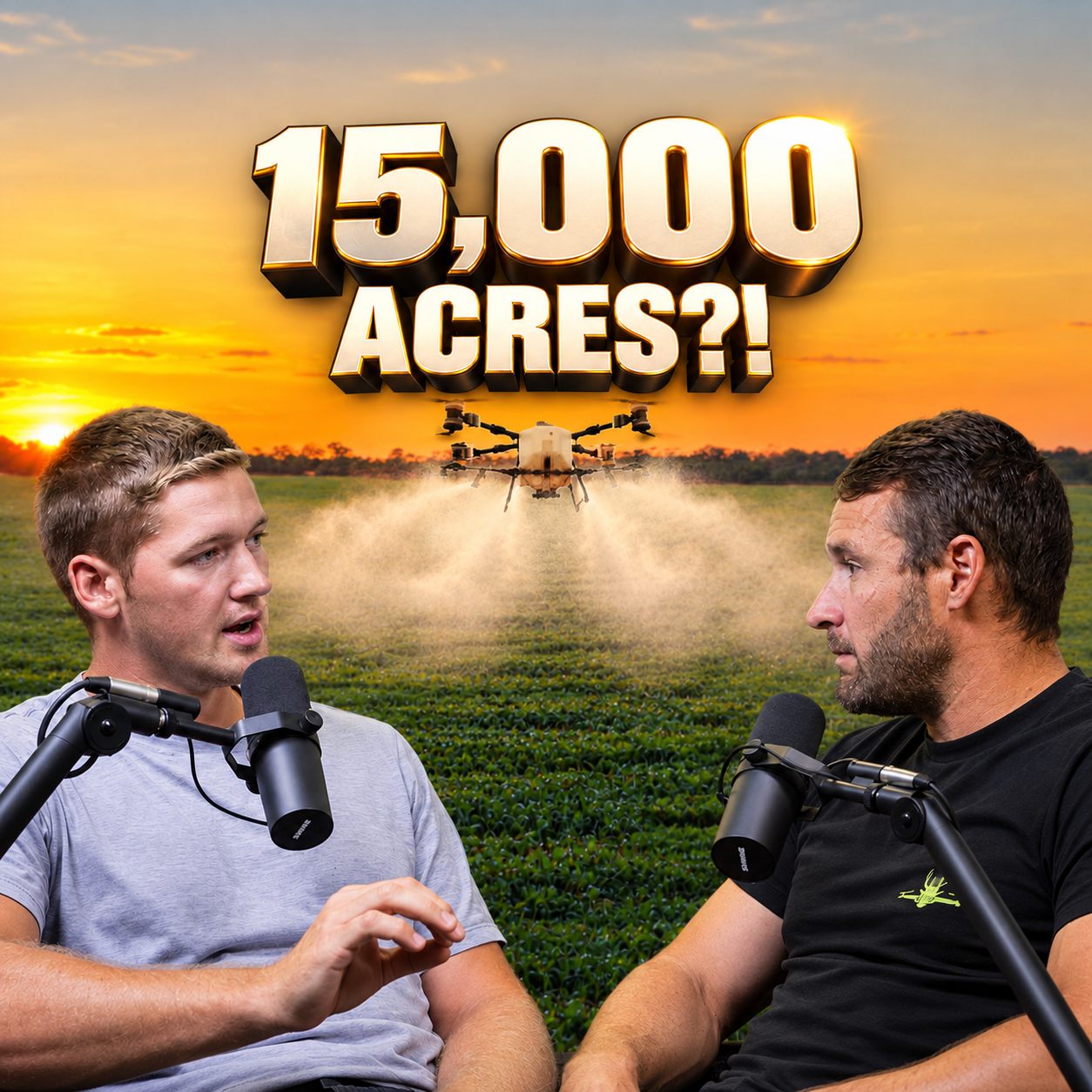
[00:06:26] Speaker B: 15, 650 something.
[00:06:30] Speaker A: Wow. So was that mostly by yourself?
[00:06:32] Speaker B: Yeah.
[00:06:32] Speaker A: How much of those acres were in Indiana?
[00:06:35] Speaker B: A75.8. Right around 8,000.
[00:06:38] Speaker A: Okay. So you did a lot in Ohio then too?
[00:06:40] Speaker B: I did a lot in Ohio. Wow. I was. And the 8,000 that was Madison was helping. My brother Dwayne was helping with that. But other than that, I was pretty much all by myself.
[00:06:50] Speaker A: That is insane.
15,000 that for like what I did the first year with T40s. Just seems crazy to think that you did that with one trailer and basically two drones, right?
[00:07:04] Speaker B: Yeah, yeah, yeah, yeah, yeah. And the other thing, that's wild.
I mean, you put in a lot of hours. But I was thinking back just this last week when it really started getting busy wasn't until like the last week of June. So we're, you know, we're in September now, but it's was up until about mid August. So you're looking about a two month window where most of that happened between Indiana and Ohio.
[00:07:34] Speaker A: Yeah.
[00:07:34] Speaker B: Yeah.
[00:07:34] Speaker A: Do you feel like our growing times were different from southern Indiana to where we're in?
[00:07:40] Speaker B: Yes.
[00:07:40] Speaker A: And that helps spread out that season.
[00:07:43] Speaker B: So even, even an hour north in Indiana. So we were down in Jasper, southern Indiana.
There was a farmer that I connected with that was like an hour and a half north of Jasper. His growing or his corn wasn't ready until about a week and a half later. So it worked out perfect. We did a good run. Southern Indiana, as they were starting to finish up, we moved north, did the northern. It wasn't northern Indiana, but a little further north. Then we got over to Ohio, started southern Ohio, worked up a little more north, a little more north, until up
[00:08:16] Speaker A: here in Worcester, you have a wife and kids. How's that work? Being a spray drone pilot out there working, you've got to have a good wife.
[00:08:28] Speaker B: You gotta.
[00:08:29] Speaker A: She got tired of it yet?
[00:08:31] Speaker B: She gets tired of me being gone. But at the end of the day, and we seriously considered it this year when I got back from Indiana and even towards the end of the fungicide season, we did sit down, we said, is it actually worth it? Because I was gone just a lot. Like you're gone three in the morning and you're not back until sometimes the next morning. Like you don't really know your schedule.
So in Indiana, they did come out and visit. We had an Airbnb there where they came out, you know, but there's not a whole lot you can do because you got to spray.
[00:09:05] Speaker A: Yeah.
[00:09:06] Speaker B: So at the end of the day, she's like, she doesn't. She's tired of me being gone so much. But he's like, for the first time, really, and since we've been married, really, she's like, I can actually see to where some of these goals that we are, dreams that we have, owning our own house, of having a property are actually like she's like, they actually are achievable. Okay, we're actually starting to see it. So I said, so what you're saying then is the income accommodates for it? And she's like, yeah, if, if we can keep making enough, making what we have been just from the spray stitch, he's like, we can sacrifice.
[00:09:42] Speaker A: Did you think at all could you teach high school boys how to run these drones and you not have to be gone as much or not really an option.
[00:09:53] Speaker B: So Dwayne's 15 years old and his primary job was fill the drone and change batteries.
About two days in because he's got a little drone of his own. About two days in, chaos starts happening. I'm like, fly this drone back. And it did not take long until he knew what was happening. He knew how. I mean, they're not that hard to fly. So he's a sky, he's a high school kid and he, by the end of two weeks of doing it, he
[00:10:22] Speaker A: knew he had it, he had it figured out.
[00:10:25] Speaker B: So now I asked him, I was like, so what do you want for, you know, future, what's your next year type of thing? So where he's at with it now is he enjoys for operating the drones and stuff to where he's like, yeah, I, he could do that. So I think that's definitely. It's not that hard to do that.
[00:10:42] Speaker A: You need a couple guys like that that go talk to their friends that are in high school and motivate them to go fly as well. Aaron Clark. And we'll have him on the podcast at some point. I feel like he did a really good job with that. He, he got some high school boys and they're basically running his rig. I think sometimes we look at it, including myself, it's like I know how fast I can get something done and how good I can be at it.
And just not trusting other people will actually hinder our growth 100%. Yeah. So if there's anything I could tell people that are listening or watching is, yes, you can probably do it faster, maybe better.
Maybe better.
Kind of if you teach your guys the correct parameters, then the drone does the work. But if you want long term growth, right, you were hustling, trying to make ends meet and make some money. But I do think that if you'd start allocating and managing people, it would be a longer run of being a spring drone pilot.
[00:11:47] Speaker B: Absolutely.
[00:11:48] Speaker A: Yeah. So you also do thermal work. We're about to get into that stuff here in, in the fall, you're headed To Kentucky. Are you going to do some thermal work down there or is it just mostly just hunting?
[00:12:00] Speaker B: I'll take it along, but hopefully I don't need it. Yeah, I'm using a longbow though, so.
[00:12:04] Speaker A: Oh, you Are you long behind? Yeah. I did not know that, like strictly.
[00:12:09] Speaker B: No, I, I do compound too, but this would be my first year, like hunting traditional.
[00:12:14] Speaker A: Oh, you're going all in this year?
[00:12:16] Speaker B: Yeah.
[00:12:16] Speaker A: Dude, I love longbow hunting. It is, it is the hardest thing to do though. Like, I was good at target shooting. I could shoot a 20 yard, you know, group like this, like three inches. Pretty solid. But then when it comes to shooting a wild animal, completely loses it. Like, I miss so many deer. It is embarrassing. Yeah. Cuz I just totally forgot to tell myself to look at the spot where I want to shoot.
[00:12:44] Speaker B: You got to is so different than any other hunt. You got to zone out like it's, it's a different, different focus. But I've been kicking around with it for a while and last year I shot. I was just a lot of compound hunting. But it got to the point to where for me it's not as much the kill as it is the chase.
[00:13:00] Speaker A: Yeah.
[00:13:00] Speaker B: And I got to parts where so many of my kills last year were 12 yards and under. And I'm like, I can do this with a longbow.
So I was like, okay. This year we're.
[00:13:10] Speaker A: So is that tree stand hunting or on the ground?
[00:13:13] Speaker B: Yeah, mostly tree stand.
[00:13:15] Speaker A: H. But yeah, I tried longbow for three years until I got a deer. Finally I just settled for a button buck. He was just right below me and so I. Poor little buck. Yeah, that's all, that's all I could get. It was brutal. But I would definitely entertain the idea of trying it again. How many years ago was this, Mike, that you were going with the longbow? Yeah.
[00:13:34] Speaker B: Yeah.
[00:13:35] Speaker A: So you said three years.
Is that five years ago? Oh, no, it was longer that, oh, 10 years ago. Yeah, it was probably, I'm gonna guess, around eight to ten years ago. Yeah. We should throw up some pictures. It was, it was a mess. I would, I would load out my quiver like at times because the deer didn't know where it came from because it's so quiet. It's just, and there's a couple times I had to go pick up all my arrows because. That's funny. It was not funny.
[00:14:03] Speaker B: I mean, I, I, I've been shooting rabbits and knickknacks stuff.
[00:14:07] Speaker A: So.
[00:14:08] Speaker B: Yeah, they get in the garden, they're toast.
[00:14:10] Speaker A: Wow, that is impressive. You Must be pretty good.
[00:14:14] Speaker B: I would know if. I don't know if it's good, but it's fun.
[00:14:16] Speaker A: But you've never shot a whitetail.
[00:14:18] Speaker B: I've never shot a whitetail with it.
[00:14:19] Speaker A: What's your setup?
[00:14:21] Speaker B: I have a 62 inch longbow, 50 pound draw weight and use 125 grain, like a fixed blade. That's what I'm shooting.
[00:14:31] Speaker A: I use this arrow. It's absolutely insanely, ridiculously expensive. Grizzly stick. Have you ever heard of it? Oh my gosh. It's. Yeah, check them out.
[00:14:41] Speaker B: What is it? It's an. It's just an Easton carbon arrow. But they're like. They're like 20 bucks arrow.
[00:14:45] Speaker A: Yeah, gosh. Mine were not. It was brutal. But that's why you got into drones. You know what is crazy about longbow hunting is yes, you might be shooting something with a stick and a string, but it is so advanced compared to what it would have been if you would have had to carve your own bow out of a branch.
[00:15:05] Speaker B: I've tried that. It just. It's a struggle. Oh yeah, it's a struggle. I've never killed anything with anything I carved, but that's where I started. It was fun to fiddle with and find them.
[00:15:16] Speaker A: Like you had said that this has changed your life as far as. Is this worth it? Are you making more money than you would if you'd be in construction?
[00:15:25] Speaker B: Yeah, yeah, definitely.
[00:15:26] Speaker A: And is that just because you're putting in more hours or doesn't pay better overall?
[00:15:32] Speaker B: It pays better.
You do put in, well, average. I don't know. For a time you put in more hours. But now like next week I want to go to Kentucky. It's like, okay, let's go to Kentucky.
[00:15:43] Speaker A: Yeah.
[00:15:43] Speaker B: You know, it's like I don't have to work all the time. There's a two month period to where it's just all out.
But then in the spring I went to West Virginia, Indiana and Michigan. Turkey hunting.
[00:15:58] Speaker A: Wow.
[00:15:58] Speaker B: And in the fall, you know, before. Before I start guiding, then I. I always like go out of state at least.
[00:16:04] Speaker A: So you're a guide as well?
[00:16:05] Speaker B: Yeah.
[00:16:06] Speaker A: Tell us a little bit about that. How did you get that job or what do you do?
[00:16:10] Speaker B: So pretty much we have a. We have a professional guiding business to where hunters, mostly people, most of them are non residents who, yeah, they book a hunt. And pretty much my job is to set up the baits, the tree stands. People who may have never hunted, don't know much about hunting. Others are well experienced hunters who just want an experience out of state. And I'll take them out and set them up and try and get them the best shot at the best deer.
[00:16:36] Speaker A: So you. You take them out side by sides and just tell them there's a deer stand, get in it.
[00:16:40] Speaker B: Yeah, pretty much drive up to the deer stand, get them in. I'll check the wind, watch the wind and everything, and either be.
[00:16:46] Speaker A: Oh, so you kind of. You don't just take them to one stand all the time.
[00:16:50] Speaker B: No, it's based on the wind because
[00:16:52] Speaker A: you want that issue.
[00:16:53] Speaker B: And it's based off hunting pressure, too, because, like, so if there's a big deer here, like, we've had several instances to where a big deer has been hunted for three weeks straight and hasn't been killed yet, but he's still showing up. Right. So we. The biggest things. We watch the went and try to make the. So the deer doesn't know he's getting hunted. So we can keep hunting them. Right. But there's other times where they get blown out and you got to shift to shift different.
[00:17:20] Speaker A: How many acres are you guys working with?
[00:17:21] Speaker B: We've dropped quite a bit. I mean, this year I think we're only taking 50 hunters. Totally.
[00:17:26] Speaker A: Only 50 hunters.
[00:17:27] Speaker B: Yeah. That's compared to like 150.
[00:17:30] Speaker A: What? Yeah.
[00:17:31] Speaker B: At 150, you're just.
[00:17:34] Speaker A: Holy moly. That's a bunch. Yeah.
[00:17:36] Speaker B: You're just milking it. But we got. I don't even know what it is. It's. It's broke up in a bunch of different acres, like partials. Right. And if I had to guess, I'd say we're.
We may be 2,000 acres, something like that. Yeah.
[00:17:52] Speaker A: 2,000 acres. Across how many states?
[00:17:55] Speaker B: One state, but it's about.
[00:17:57] Speaker A: It's.
[00:17:57] Speaker B: It's across.
[00:17:58] Speaker A: It's just two counties. Ohio. Yeah. Two counties.
[00:18:00] Speaker B: Yeah, Two counties.
[00:18:01] Speaker A: Wow. Tasha. Robbins county or Muskegon County.
[00:18:04] Speaker B: It's Licking and Knox looking.
[00:18:06] Speaker A: No, those are decent counties. Yeah, they're good. Yeah, they're really good.
[00:18:10] Speaker B: But it's like last year we averaged about 50. Success rate, typically is about what it averages.
[00:18:16] Speaker A: So how did you get into that business or into that line of work? Because it's not your business. No. Right.
[00:18:22] Speaker B: Nope. Nope. It's just. I just. I work for the outfitting, but I was local there. I loved. I've always loved hunting. And like I said, I. For me, it's not as much about the chase. It is the management side of it, and. And the setup. Like that is what I enjoy doing. And so he's like, well, he might have a job for me. So I went over, met with him, and that's where it all started.
[00:18:45] Speaker A: And I'm like, yeah, this was before the thermal drones.
[00:18:49] Speaker B: This was before. This was the same year that I got my thermal drone.
[00:18:53] Speaker A: Okay.
[00:18:53] Speaker B: But I hadn't had a season in yet. And he's like, well, they've used it. I think you had found some deer for him.
[00:18:58] Speaker A: Okay.
[00:18:59] Speaker B: And he's like, this will have a good. A good part of it. Because he said one of his concerns typically was if they shot a deer, they usually wouldn't be able to hunt that stand for two weeks.
[00:19:12] Speaker A: Why is that?
[00:19:12] Speaker B: Just because it would. It would just flush everything out when
[00:19:15] Speaker A: you go to retreat, when you go
[00:19:16] Speaker B: to retrieve the deer. So they started seeing when they used a drone, they could hunt it the next day with no intrusion. Now, however, why is that, though? Because what, they would literally drop a pin, drive in with a four wheeler, load it up, and the deer.
[00:19:32] Speaker A: Okay, so give me the other scenario where it blows it out.
[00:19:36] Speaker B: Oh, we would. If you don't. Some of these hunters, I mean, for the most part, they're decent hunters, but some of them we've had come in, they've never. They. They shot their. They bought their bow from the shop, and that's the last they shot or was it even shot? Right.
[00:19:50] Speaker A: So. But you're giving me a story where it was a wounded deer and then
[00:19:54] Speaker B: you're just checking they shoot him in the back leg and you're trying to find this deer. Oh, okay.
[00:19:59] Speaker A: So now you won't do that because you'll. You'll find him with the drone and you'll be like, okay, if, if, if
[00:20:04] Speaker B: it's questionable, we'll just fly the drone. I'll. I'll fly the drone, figure out where it's at, what's happening with it, and yeah, make your best assessment.
[00:20:16] Speaker A: The outfitters, probably. Success rate.
[00:20:19] Speaker B: Oh, yeah.
[00:20:20] Speaker A: Oh, as far as, like, getting hunters on deer.
[00:20:24] Speaker B: Yep.
You don't flush it out.
[00:20:26] Speaker A: That is good.
[00:20:27] Speaker B: Yep.
[00:20:27] Speaker A: Yeah. And you would know that better than I would because I've never been in the outfitting business and know all the pressure that goes into. There's actually.
[00:20:34] Speaker B: There's a lot. And it's hard because if, If. The smaller the acres you got, the more you got to watch your pressure. And so it's. We try and keep our access as good as we can. Hunt edges, wind. There's a whole bunch of scenarios that go with it, but all it takes is one time trudging through the woods, and you can blow the whole farm up.
[00:20:54] Speaker A: Yeah.
[00:20:55] Speaker B: And you're done.
[00:20:56] Speaker A: Huh.
[00:20:57] Speaker B: So then the next group of hunters come in, and it's like, well, this spot has nothing. And really, we didn't have. We didn't have that at all last year.
Last year, actually, the. There was one deer the whole season that we never located. Oh, the ones that was wounded. Yeah.
[00:21:13] Speaker A: Wow.
[00:21:13] Speaker B: There was. I don't even think two years ago, that was the one. Last year was 100%.
[00:21:18] Speaker A: Wow.
[00:21:18] Speaker B: That is every deer that was shot.
[00:21:20] Speaker A: Yeah. And I think if you can get there sooner rather than later, oftentimes you'll. You'll at least get eyes on the deer before he, like, moves out of the area. That's what I'm telling guys now is with thermal drones, the cost that they are. I know it hurts our business, like what you and I have on doing service calls, but guys are going to have these in their truck.
[00:21:39] Speaker B: Yeah.
[00:21:40] Speaker A: It just makes no sense. You wouldn't. If you've already spent 15, $20,000 on this deer, you want to go shoot with your blind, Your. Yep. You know, we go through it a lot on the podcast on how much money is spent and go, you know, trying to shoot a deer. Why wouldn't you not have that tool? If you put a bad shot on one, Go back to your truck, get the drone, get a look at him.
[00:21:59] Speaker B: And I know there's. I listen to a bunch of hunting podcasts. They're like, oh, the drones.
[00:22:04] Speaker A: Oh, yeah, yeah. Don Higgins is absolutely hating it, right?
Hating it.
[00:22:10] Speaker B: And he says, well, don't shoot over 20 yards. It's like, okay, well, you can't. Even at 20 yards, you can still make a bad shot. It just is.
[00:22:20] Speaker A: Yeah, yeah. I mean, to each their own. But I. I get it. Right? He. He has his opinion. But, dude, there's been many, many deer recovered that would not have been recovered. Put it in the right hands, it can be used for good. And I.
[00:22:35] Speaker B: And I see his point as far as the negative, but I also say poachers will be poachers.
[00:22:39] Speaker A: Oh, yeah. Even with his big old drone scanner
[00:22:42] Speaker B: thing, he's got 100%. 100%.
[00:22:44] Speaker A: Yeah.
[00:22:44] Speaker B: Poachers will be poachers. Criminals will be criminals. It is what it is.
But what I can't. And this is where I can't get behind it, because I had 70 searches last year, right thereabouts. And of those 70 searches, I had 64, 65 deer that I found. So there was only a small percentage I didn't find of the Whole season now. What percentage of those were dead varies a little bit.
[00:23:11] Speaker A: Yeah.
[00:23:12] Speaker B: But of the deer that I did find that were dead is saved that many more deer.
And so I can't not.
And we're seeing it. Even if you talk with Jeff the outfit, the guy that owns the outfitting, he says there's more bigger deer today than he than ever in his outfitting years now. And he traces it back to one. There's more managing going on. But on the other side, there's not near as many deer that are going to waste.
[00:23:40] Speaker A: Hmm, that's good.
[00:23:42] Speaker B: And just locally there, I mean, it's there. Most people, if they shoot a decent buck, they'll call me typically within the day if they, if they don't go down, you know. And so I found a lot of deer there in the neighborhood bordering properties and stuff. And it just. Overall is better.
[00:24:00] Speaker A: So this will be season three for you or three? Season three, yeah. Because I think this is season four. Season four or five. Yeah.
How old were you when you started?
[00:24:11] Speaker B: 22.
[00:24:12] Speaker A: Oh gosh, you're still so young.
[00:24:14] Speaker B: I'm only 26.
[00:24:15] Speaker A: Yeah. So cool. H. So can you tell us how much you made? Like that is so much more than a construction worker.
[00:24:22] Speaker B: Like of the, of the grant of the whole thing.
[00:24:26] Speaker A: Yeah, the grand.
[00:24:27] Speaker B: And the thermal side on average, like last year, I. Which I track everything I do of the. Of the drone stuff, but I did $20,000 worth of deer recoveries last year.
And so I mean that pays your equipment, everything easy and on.
[00:24:44] Speaker A: But you probably already had it paid off. Yeah, actually you did have a crash.
[00:24:47] Speaker B: I did and then I had a crash. But it covered both.
So my first year I paid it off. Second year I paid both off. So it's, it's still the same, but on the thermal side of things this last year. So from middle of June, which there was some earlier, but I figured about a two month period. A solid two month period. The spray drone spreading drone business.
[00:25:06] Speaker A: Oh, okay. So you, you started off with thermal. You meant the spray drone business.
[00:25:11] Speaker B: Yes. So the spray drone business. Now just in the last, in this last summer, the revenue was closed right around 150.
[00:25:19] Speaker A: That's your cut? That's not the company.
[00:25:21] Speaker B: No, that's the grant. The whole company cut. My cut out of that was.
Would have been.
It was probably right around 60,000, something like that.
[00:25:30] Speaker A: So is that lower or higher from one year to the next in the spray drum business or don't you know what, what they were doing before?
[00:25:39] Speaker B: I don't know. Exactly what they were doing before. I think it's. It's pretty average, pretty standard to what it was last year.
I'm curious to see because we'll. I want to sit down with Dennis and see exactly what it actually did.
[00:25:50] Speaker A: Yeah.
[00:25:51] Speaker B: But if you're looking my cut, typically in the construction world I was 65 to 75,000.
Whereas this year between, you know, just drones alone, I'll be probably more around the 85,000 range of take home. Yeah.
[00:26:09] Speaker A: Wow.
[00:26:10] Speaker B: That'll be of my own. And then on top of that, I still do the guiding, so.
[00:26:14] Speaker A: And you have more time than you did.
[00:26:16] Speaker B: Yeah.
[00:26:17] Speaker A: With. As a construction guy.
[00:26:18] Speaker B: Yeah.
[00:26:19] Speaker A: That is so cool. That is so cool.
[00:26:21] Speaker B: That's why it's like, like now. Like last night, my two year old daughter wanted to go baiting with me. So we go baiting. Or you name baiting.
[00:26:29] Speaker A: Putting corn out for the deer.
[00:26:31] Speaker B: Yep.
[00:26:31] Speaker A: When are you gonna start just using your drone to do that?
[00:26:33] Speaker B: Oh, I need to do that. This.
[00:26:35] Speaker A: God, that gets. That'll get fired up. I don't remember that clip that went crazy on that one podcast. Oh, that'll get him fired up.
[00:26:42] Speaker B: I love that. But yeah, the guy, I was actually talking with him yesterday, I was like, you know, I need to start just doing drone deliveries.
[00:26:50] Speaker A: Oh, dude. Like, you wouldn't ever have to go in there.
[00:26:52] Speaker B: Yeah, you just.
[00:26:54] Speaker A: I know.
[00:26:54] Speaker B: Fly it up there. There's so many down in my area. There's a lot of guys that pay the drivers to take them down there. Like, there's a lot of Amish guys who don't drive themselves, so they'll pay someone to go put corner. I'm like, why? I live down there. Oh, my God, I could do this so much cheaper.
[00:27:13] Speaker A: No one talked about this for over two years now. Like, somebody's got to do it. Like, somebody is going to do it.
[00:27:19] Speaker B: It's got it.
[00:27:19] Speaker A: Yeah. Somebody is going to do it. Where It's. It's just a subscription.
[00:27:23] Speaker B: Yeah.
[00:27:23] Speaker A: You want two drops every two weeks. This is how much it is. And the drone will go out there. I don't ever have to go on your land. Drone will go out there and it'll drop.
[00:27:32] Speaker B: Just drop it right there.
[00:27:33] Speaker A: Yeah.
[00:27:33] Speaker B: Spread it out on a field. Do whatever you want to do with it. Because the other guys are so anti baiting. I'm like, well, then take your corn and spread it out across your hay field.
No different than hunting a cornfield.
[00:27:42] Speaker A: There you go. I agree. It literally wouldn't be. No. Because you know, those guys are planting Cornfields and then they mow.
[00:27:48] Speaker B: Yeah.
[00:27:49] Speaker A: A section of it. Yeah. It's just. It's a different form of baiting.
[00:27:54] Speaker B: Yep.
[00:27:55] Speaker A: It's just a huge 20 acre field where you have it congregated like this. Yeah. Huh.
So that's like.
[00:28:03] Speaker B: Yeah.
[00:28:04] Speaker A: Just haven't done it yet.
[00:28:05] Speaker B: Nope.
You get more time.
So how.
[00:28:08] Speaker A: How big does a deer have to be for you to shoot it with your longbow?
[00:28:13] Speaker B: Like in Kentucky or home? Because I've got. I've got a pretty big one I've been watching on public and on public. Oh, it's on public.
[00:28:20] Speaker A: Nice.
[00:28:20] Speaker B: Because that's the other thing everybody's been. I shot a pretty good buck last year and a couple of my buddies and I, we always go together and it's just. It's just a joking thing, but Everybody puts in 20 bucks. Whoever shoots the bigger buck takes it home.
[00:28:32] Speaker A: Yep.
[00:28:32] Speaker B: And I've won it the last two years. And now that everybody's like, well, you could. You need to do it on public. And I said, well, I'll do it on public with my longbow.
[00:28:39] Speaker A: Oh.
[00:28:39] Speaker B: And I've got one in the site, so we'll see how it pans out. But.
[00:28:43] Speaker A: So will you try to close in on that deer early season or will you wait till run?
[00:28:48] Speaker B: Depends on. So right now he's daylighting on public, which is no bait. I just simply found a travel pattern for him. And he's there mornings and he's there night and daylight.
[00:28:58] Speaker A: Wow.
[00:28:59] Speaker B: So if it keeps doing.
[00:29:00] Speaker A: But do you have any other idea where he's going? Like, you just know he's going through there. But do you know where he's going?
[00:29:06] Speaker B: Yeah, I know he's going from bedding to feed. There's ag fields on down.
So he's. He's betting in this draw and.
[00:29:14] Speaker A: But you won't blow him out if you go in there?
[00:29:16] Speaker B: Not. Not if the wind's right. The winds is. Wind is going to have to be perfect and the pressure is going to have to be right.
So if it's not right, and I have a cell camera there so I can tell what he's doing somewhat. But if it all he moves according to the wind. That just is what it is. So. But the way it's said.
[00:29:33] Speaker A: So you've got it so dialed in that say it's a south wind, he won't show up on camera. But if it's a west wind, then he will.
[00:29:41] Speaker B: Yeah. Yeah. Yep.
[00:29:43] Speaker A: See, I just never got into hunting like that.
[00:29:45] Speaker B: Oh, it's. It's A bug. It's bad. Like, you'll lose sleep over last night. I couldn't sleep because he was there a bunch yesterday.
[00:29:52] Speaker A: It's not even deer season yet. Henry, you can sleep.
[00:29:56] Speaker B: No, I was awake at two in the morning and I. I was awake for probably an hour and a half this morning just thinking about it.
[00:30:04] Speaker A: I know, it's bad.
That's funny, huh? But, well, hey, at least you're doing something you like. Yeah, that's cool. Have you taken your children hunting?
[00:30:13] Speaker B: Oh, yeah. Yeah, she went hunting before she could walk.
She touched the heater and started crying and we shot a deer.
[00:30:20] Speaker A: Wow.
She probably didn't touch the heater ever
[00:30:25] Speaker B: since, but she's all excited about hunting this year. Every. She likes going checking cameras and hanging stands. I mean, that's. Yeah, that's pretty much my life now.
[00:30:36] Speaker A: That's cool. What's. What's your long term plan with this drone business thing?
[00:30:43] Speaker B: So right now we, you know, ran numbers with it from last year, the thermal drone. Obviously, I want to keep doing it and I want to pass it down for the kids. One of my goals is I want to be able to work with the family, but I want them to also be able to make good money early.
You know what I mean? And so it's right now then this is my mindset of it, is it can be as simple as starting with swapping batteries. We can be together on a trailer. They can teach, you know, learn how to work. They can, you know, do the whole. Do the whole thing.
[00:31:18] Speaker A: Yeah.
[00:31:19] Speaker B: They'll get to a point to where they can fly the drones and then they can do what they want with it.
[00:31:24] Speaker A: Yeah.
[00:31:25] Speaker B: You know, but what I like about it now is it'll give me time with the kids where we can all make good money. And then if they want to keep going with it, they can keep going with it. But I've made too much money in it now already with the thermal and the spray drone business to not keep doing it.
[00:31:41] Speaker A: Yeah.
[00:31:41] Speaker B: So it's hard for me to say, okay, well, I'll back out, do something else.
[00:31:45] Speaker A: So you don't think that you'll have more thermal work than what your one drone can do to where you would have multiple drones?
[00:31:55] Speaker B: Very possible. Last year I was. I sent a lot of. A lot of calls off.
[00:32:00] Speaker A: Oh, you did?
[00:32:00] Speaker B: I did.
[00:32:01] Speaker A: So to other people.
[00:32:02] Speaker B: Yep. So my brother's been looking into.
He doesn't have a drone. And I'm like, well, what if I get another drone? You run the drone, you fly the drone.
[00:32:11] Speaker A: Okay.
[00:32:11] Speaker B: Okay.
[00:32:11] Speaker A: Your 15 year old brother.
[00:32:13] Speaker B: Yeah.
And I have another brother that's like a year and a half younger than me and he's kind of in the same boat. He's like, yeah, do it. So I've got. I know of three different people who already were like, yeah, if you got the drone, they get their license and, and fly it for me. So that's kind of what I'm gearing towards now. I mean, I enjoy it so much though. It's.
[00:32:32] Speaker A: Oh, it's fun.
[00:32:34] Speaker B: It becomes, it becomes addictive.
[00:32:36] Speaker A: Oh, 100%. It's like, it's hard to not go do a recovery when somebody calls you.
[00:32:41] Speaker B: Oh, yeah. It is really hard not to go.
[00:32:44] Speaker A: Yeah.
[00:32:44] Speaker B: And so.
[00:32:45] Speaker A: Because you know that feeling. Yeah. Like so hard to explain. It's like, yeah.
[00:32:50] Speaker B: So my 15 year old brother, obviously, like his total plan is getting into drones. Like that's what he's planning on doing.
[00:32:57] Speaker A: What's he doing now?
[00:32:58] Speaker B: Just works in the cabinet shop and he's. He did homeschool this year, so you'd have more time. But he wants to go with me on recoveries because there's more than you learn though, than drone flying drones. I mean, you learn how to talk with people, you learn how to deal with people. You. It's your own business.
[00:33:14] Speaker A: Yep.
[00:33:14] Speaker B: And. And it's what the way you present yourself is what a lot has to do with whether you make it or not.
[00:33:20] Speaker A: Yeah. That being said, the, the spray drone business, that's not your business. Are you going to do your own business or what are you thinking there? I mean, Dennis probably doesn't want me to ask you that.
[00:33:33] Speaker B: Well, we'll see what, we'll see what he.
Down the road and I don't know exactly, you know, at what point it is. I can totally see it to where I will own my own business. Yet at the same time, it's worked out really good in this case to where I've not had to put any money in. He already has the operation, the rig and everything.
And I just run his rig. I've been able to learn everything there is to learn. I mean, there's still more to learn, but the bulk of it to where now it wouldn't be hard for me to go buy a new rig, get a new trailer, get new drones and stuff because I know it'll work.
[00:34:11] Speaker A: Yeah.
[00:34:11] Speaker B: And I know how, how I'm going to work, you know, so. Whereas a year ago I would have been like, yeah, man, that's a lot of money.
[00:34:18] Speaker A: Yeah.
[00:34:19] Speaker B: Not knowing if you're going to make it back.
[00:34:20] Speaker A: You just don't realize how many acres there are to spray and how many.
[00:34:26] Speaker B: It hasn't even started. Like it hasn't even started.
[00:34:30] Speaker A: I know.
[00:34:32] Speaker B: There are so many farmers who are like, oh, you got a drone. That's cool.
[00:34:36] Speaker A: Yeah.
[00:34:36] Speaker B: And they'll kind of turn the back. I'm like, okay. Yeah. I mean they don't even have any idea. They're like, I can't do anything. There was one farmer this year I sprayed for so his beans, his ground rig, a couple of the nozzles weren't spraying and so he got striping through his whole field of weeds and you could see it. And he's like, I really don't want to go drive through the beans again. He's like, I'll pay you 15 bucks an acre or whatever I charge him. I think it's 15 an acre to come spray his field. And it was just spot spraying. And he came and he watched and he was just like, he, he had no idea. He's like, I. He had seen like the, I think it was the 40 or even earlier in the 40 he had seen and he was like, it'll never make it type of thing.
[00:35:18] Speaker A: What?
[00:35:19] Speaker B: Yeah. And so, but he seen I was using the T100 and he was like, it. So it opens the canopy, works it in and everything.
And he told me later, he said, if I drive my ground rig through there, I can pretty much figure I will lose three to four bushel the acre of damage.
[00:35:36] Speaker A: Yeah.
[00:35:37] Speaker B: So if you figured the price of beans, three to four bushels the acre twice a year, he would be losing money. Plus it's his rig and he's paying whoever's spraying. So he's actually losing by spraying by himself.
[00:35:54] Speaker A: So he should be convinced on getting you to do all of his fields.
Huh. That's good.
[00:35:59] Speaker B: He kept adding more. He kept adding more and finally he's like, yeah, this just, this is a no brainer.
[00:36:05] Speaker A: That's so cool.
[00:36:06] Speaker B: So that's why I say like, it hasn't even. There's so many farmers who don't.
[00:36:11] Speaker A: Yeah.
[00:36:11] Speaker B: They actually like, they see it and it's like, yeah, that's cool. But it's like they don't understand.
[00:36:16] Speaker A: Yep. Something we haven't gotten into much with the drones and they're so capable is variable rate stuff because I was talking to an agronomist that they check the beans and if they need boron, maybe this section of field needs a higher volume of boron than the rest of it. The Rest of it still needs something, but not as much. And he's saying he has all the numbers to prove to the farmer. If he would add this volume of boron on the beans right here and a lower volume here, how much that overall increase would, you know, pay for the application itself.
[00:36:50] Speaker B: Yeah.
[00:36:50] Speaker A: So variable rate with drones here in Ohio, what we've been doing, we haven't been doing it because most of the farmers just want to do a blanket coverage. But I think out, you know, west into those bigger fields, variable rate will become more and more.
[00:37:04] Speaker B: Yeah.
[00:37:05] Speaker A: Sought after because the chemical costs, you can keep it down because you're not just doing it on the whole field, you're just doing those specific areas. So. Yeah, I totally agree. Like, we're. We're literally just getting started.
[00:37:19] Speaker B: Oh, yeah.
[00:37:20] Speaker A: As a whole. The whole industry.
[00:37:22] Speaker B: And that's why, like. And down the road is like, I.
You got to start somewhere in it. And it's like, the sooner you get started in the industry, like, I started was it two years ago. I started last year. I helped Dennis. And now it's to where I can't quite describe how it even feels to me of.
It's gonna get to a point where this is. I don't even know if they're gonna be using anything other than drones, you know, like, there was this farmer I sprayed for down in southern Ohio where. So he got up on the trailer, so he wanted to watch and everything. So I got asked him like, so why? Because it was like the prime airplane fields, like big fields. And he's like, he used the drones for the first time and he said his overall coverage was just way better. Wow. Because the corners, he's like, it was the same across the whole field. It was. The corners were good, power lines were sprayed, trees were sprayed. Like it was.
Everything was sprayed. So I asked him, okay, so if I miss a spot, are you going to be able to tell the difference? He's like, oh, yeah.
[00:38:25] Speaker A: Oh, yeah.
[00:38:26] Speaker B: He said he has seen it as much as a 30 bushels per acre difference.
Now you look at the price range of that.
[00:38:33] Speaker A: Oh, yeah.
[00:38:34] Speaker B: It's like, okay, well, that's a no brainer.
[00:38:35] Speaker A: Yeah.
[00:38:36] Speaker B: And he's like, yeah, as long as he's farming, he's. And he's like, he just wants drones. He doesn't want anything other than drones anymore.
[00:38:42] Speaker A: That's cool. Yeah. I tell people that as well. And they're like, that's just a sales pitch. But it's true.
[00:38:48] Speaker B: It is true. Like, you can't. You can't beat it. Yeah, it's not going to.
[00:38:54] Speaker A: Yeah. How many drones did you have go down this year compared to last year
[00:39:00] Speaker B: while we had 150 just fall out of the sky for no reason.
I'm guessing it was probably some wire issue on the inside because I did find others like the wires that started kind of melting together and I don't know, was it just a connection issue? I don't know what it was.
So that one just fell out of the sky.
I had another one that I just clipped a limb and it shattered the air, the propeller and threw it off balance and it went down. But it wasn't. That wasn't a bad one, the T100. I put it through one power line.
[00:39:32] Speaker A: And was that thing Toast?
[00:39:34] Speaker B: No, just two ESC.
The two front ESCs were blown, but that was it.
[00:39:41] Speaker A: That's cool.
[00:39:41] Speaker B: Like literally that was it. But I think what saved it is because it cut both lines.
[00:39:45] Speaker A: It literally cut the line. Yep.
[00:39:46] Speaker B: Cut both lines. So it didn't get wrapped up in it.
[00:39:50] Speaker A: Was it aligned with power?
[00:39:53] Speaker B: Yeah.
[00:39:53] Speaker A: What the power company say they were
[00:39:55] Speaker B: like, well, this ain't the first time it's happened. Ain't the last time it's gonna happen. Put it back together.
[00:40:01] Speaker A: No way. That's.
[00:40:02] Speaker B: They were there within like 15 minutes. I mean they knew it, knew what happened.
[00:40:05] Speaker A: Wow.
[00:40:06] Speaker B: But it wasn't. It was just. It was going into a house.
[00:40:09] Speaker A: Yeah. Okay.
[00:40:09] Speaker B: So it wasn't like a high voltage power line, but that's cool.
[00:40:14] Speaker A: So last year comparing like maybe like how many.
[00:40:17] Speaker B: What was it last year we had?
[00:40:19] Speaker A: I'm just trying to figure out if the drones have gotten better from years.
[00:40:23] Speaker B: Most definitely they have.
[00:40:25] Speaker A: Yeah.
[00:40:25] Speaker B: I would say. I forget exactly how many we had go down last year, which it wasn't a bad year either. But it was just the biggest difference that I seen in it though.
And maybe it's bad, but I trust the drones more like I trust. Obviously I trust my mapping a little more than I did in years past. But the like the power line that I hit that was just. That was literally was pilot. It was my mistake.
[00:40:50] Speaker A: You didn't see it?
[00:40:51] Speaker B: No. I was spot spraying and I seen the power line come across, but I thought it was going like I thought it turned up there and there was one line that came into a house and it was behind woods. You can see it. So I came across there.
But overall, which the lidar isn't as good as I had hoped it would be. As far as picking up. It'll pick it up, but not fast enough for the drone to react to, so you can't rely on it completely. But overall, the. I didn't like the T100 never went down because of just randomness. Randomness.
[00:41:23] Speaker A: It.
[00:41:23] Speaker B: It was. It was typically something I did.
[00:41:26] Speaker A: Yeah. I think the. The T100. The reliability of the battery. Yes, you could overheat the batteries if you were overloading your drone and you weren't getting load off fast. But the reliability of the battery, the flow meter, the. The pumps, the atomizers, I didn't have any issues.
[00:41:45] Speaker B: So even after I had. After I flew it through the power line, I didn't have a single air.
[00:41:52] Speaker A: Like, after the crack. See that.
[00:41:53] Speaker B: That's.
[00:41:54] Speaker A: That's insane. Like, because when I had a 40 go down, it felt like it was just chain reaction. Yeah.
[00:42:00] Speaker B: It affected this radar, it affected this sensor. It affected this.
Here's the other thing that's just. And I don't know, was it just pure luck or whatever, but when it hit the power line, cut both power lines and the ground wire wrapped up in the one motor, but it landed like, it hit on the landing gear.
I don't know. Is it total luck or did it actually, like. I don't know what it was, but busted an arm, broke stuff up. But all the propellers were good or the motors were good. Changed the propellers out, but it was just like.
[00:42:28] Speaker A: And again, I think sometimes because of how good the equipment is that we get to use from dji, we overlook how good it actually is, because then you go to, you know, there's other companies that are trying to get into the market because of the. The situation we're in with dji, and there's a lot of issues that those drones are figuring out in the field. And it's.
You just completely overlook it if you use good stuff all the time.
[00:42:57] Speaker B: Oh, 100% like it was. If I had to describe my.
My summer, it was the most chill summer as far as, like, it was just. There was very little gosh, like. So, like when we were flying the 40s, it was like for no reason, no connection, and you're trying to get all, you know, how am I going to get reconnected? And with the 50s, it was like sort of lost connection.
[00:43:23] Speaker A: And it's funny you're bringing that up because that's what I said when we released the platinum trailer. It's like we were never thinking of making a trailer with an enclosed cab where you can chill in the AC and just kind of watch your drones fly, because we Were always so on edge. Even though the 40s were good at that time, they had all kinds of issues and you had to get ready to run. That's hop on the bike and go. Yeah. We always had a dirt bike ready to go.
Now it's.
[00:43:50] Speaker B: I use the. I don't even. I use the bike maybe once for a connection. And it was probably because it was a mile out, but it was like nothing I couldn't get with the repeater, like with the drone.
[00:44:01] Speaker A: That is insane.
[00:44:02] Speaker B: So it was.
[00:44:03] Speaker A: Yeah.
[00:44:04] Speaker B: Yeah. We had camp chairs set up under the umbrella with a fan and a cooler.
[00:44:08] Speaker A: That is so good. Yeah. Now spraying with drones is so chill that for me, I want to go do it because it gives me time to just relax and disconnect. Before, it was stressful.
[00:44:20] Speaker B: Oh, yeah.
[00:44:21] Speaker A: But you could get it done.
[00:44:22] Speaker B: Yep.
[00:44:22] Speaker A: Yeah.
[00:44:23] Speaker B: The only time it gets stressful, you make it stressful. You're a three quarter mile out, you got eight gallons and your battery's at 15% and you're like, let me try and finish this row.
[00:44:33] Speaker A: Yeah. Yeah. Y. Yeah. It's just pilot pushing it to the limit. Y. Y.
[00:44:37] Speaker B: But if you allow the. If you allow the features. But even you could have 10 gallons in the T100 and you could be half a mile out at 20% and land on the trailer, no problem.
[00:44:50] Speaker A: Because it goes so fast.
[00:44:52] Speaker B: You could like. Yeah, I never had to empty my load trying to get back in time.
[00:44:57] Speaker A: Yeah.
[00:44:58] Speaker B: It just.
[00:44:58] Speaker A: It goes so fast.
[00:44:59] Speaker B: Yeah.
[00:45:00] Speaker A: What would you tell somebody that is thinking about getting into any one of these drone businesses, thermal or agricultural, that has no experience, like, as far as the drone, no farming experience.
What's going to be their biggest challenge?
[00:45:16] Speaker B: Probably the grit. Grit and grind.
[00:45:19] Speaker A: Yeah.
[00:45:20] Speaker B: Because it's not. The work itself's not that hard. I mean, you. You have to learn how to do equipment. But so it is with any new job, you do what is the hardest. And I seen it in Dwayne, and I seen it in myself too. Was which now it's almost fun to just see how far you can push yourself. Yeah. But you're going to get tired and have to keep going, you know, and whether you're doing thermal or not, I mean, if you're doing thermal, there's some nights I don't get back until 5:30 in the morning. You get to bed and the phone rings, you got to go do another.
And so that is honestly what I see the biggest challenge for. And I seen it firsthand in spray domes this year where I had farmers calling me and were like, yeah, I had this other guy, he sprayed for me last year, but they just weren't getting it done.
Like they just.
And I need it done now.
[00:46:13] Speaker A: Yeah. It's kind of like you and I went down there to help that co op. I don't know if you went back and sprayed more for them later, Jared Cox.
But they had two new way trailers and their guys just didn't have the grit, I think, and the, the get up and go attitude. And we went down there and helped them get caught up. But that is something that if, if you're gonna be a spray drone pilot or have a spray drone business, it's a grind.
But dude, buckle up. Put your, you know, strap in your boot laces. Let's go to work. Like, we have to be willing to work hard, period.
[00:46:51] Speaker B: Yeah, it, it is such a short time period, though. Yeah.
[00:46:54] Speaker A: I told you.
[00:46:55] Speaker B: But it's like there. That there was probably three different farmers this year that I got just because other pilots weren't. Weren't doing it.
[00:47:04] Speaker A: Yeah. I made a video about my frustrations about the drone industry about not looking professional and hard work and this and that. It's like a lot of farmers had bad experiences.
[00:47:16] Speaker B: Yep.
[00:47:17] Speaker A: But I think if we can show them a good experience, then.
[00:47:21] Speaker B: Then you're gonna pretty much have them for life. There was one farmer last year I showed up to spray for. He had called me, actually. You had send him. You had called him. He's down my area there, turns out. I mean, it was literally fields just down the road.
[00:47:35] Speaker A: Oh, yeah.
[00:47:35] Speaker B: And, and so I had been wanting to spray him, but he had another drone guy that was going to spray him for him, which not a big deal. Like, I'll keep on going. There's enough work to go around. But they had a crash or whatever. They weren't getting it done. And he was like, these fields have, like, they're behind, like, they have got to be sprayed today.
[00:47:54] Speaker A: Yeah.
[00:47:54] Speaker B: So I called him that day and I was like, he was like, how soon can you be here? And I was headed home already. I was like, I'll be there in an hour. I met up with him in an hour, mixed up the first batch. And like, he had all kinds of concerns. He was like, how many acres have you sprayed? He's like, do you actually know what you're doing? He's like, pretty much. He was afraid, like, he's gonna get ripped off just because, like, he was. He was getting pretty nervous.
[00:48:16] Speaker A: Yeah.
[00:48:17] Speaker B: So the first night I didn't start spraying until like, 8 o'. Clock. And I was like, I'll spray until. Because he didn't want dew setting. And I was like, I'll spray two hours or so. That's what I had. And I did 80 acres. It was like 85 acres in two hours. And he was like, okay.
[00:48:31] Speaker A: Oh, I remember this guy. Yeah, that was just a season.
[00:48:35] Speaker B: Yeah, yeah, Popcorn. And he was like, okay.
[00:48:38] Speaker A: He was raising popcorn.
[00:48:40] Speaker B: Yeah, it was all popcorn fields.
[00:48:42] Speaker A: He's like, I don't think I've ever sprayed popcorn.
[00:48:44] Speaker B: I had neither until that point. He's like, I got more for you tomorrow.
[00:48:48] Speaker A: That is cool.
[00:48:49] Speaker B: So I was there the next morning, started spraying. This is another thing that means a lot to farmers. If you keep track of your weather and you make the call to quit spraying because you see weather coming versus them having to tell you to quit. Yeah, that makes a huge difference.
[00:49:06] Speaker A: That's good.
[00:49:07] Speaker B: And so I try to always be proactive and if I see weather coming, I'll text and be like, hey, there's weather on the way. This is what I'm thinking. What are your thoughts? I've had farmers say, keep going. You know, I've had other farmers say, good call, let's shut it down. So you've got to. It just show. It's a small thing, but it shows professionalism.
[00:49:25] Speaker A: Yeah.
[00:49:26] Speaker B: And this farmer in particular, I knew he was, you know, he was on edge. So I tried to be on point with all of that, but in like a two day period, I had sprayed over 600. It was two and a half days. Sprayed over 600 acres for him.
[00:49:38] Speaker A: And he was like, this is.
[00:49:39] Speaker B: And he was like, that was the fastest he's ever had. And it was, it was caught up. He's like, the other guys got their drones going and he's like, I had told them I would give them more acres. He's like, I'll let. We'll see if they can handle the rest. But he's like, put me on the schedule for next year.
[00:49:54] Speaker A: Oh, wow.
[00:49:55] Speaker B: So, wow. He's on the schedule. But just small stuff like that makes a big difference.
[00:49:59] Speaker A: So that's cool. So if somebody wants to reach out to you, if they have questions, is that okay?
[00:50:04] Speaker B: Yeah, absolutely.
[00:50:05] Speaker A: How do they get in touch with you?
[00:50:07] Speaker B: Probably the best way would be through either Facebook or Instagram. Just Henry Hostetler.
[00:50:12] Speaker A: Okay. They're gonna have to know what your profile picture looks like.
[00:50:15] Speaker B: It's probably me hunting something.
And if you go on the page, there'll be drone stuff on there because. And this year I'LL be. I'm not exactly sure what extent I want to do with it yet, but I'm planning on doing a lot more.
Just small drone clips, films of what I do, that type of thing.
[00:50:34] Speaker A: So Henry Hostetler on Facebook or Instagram. Or Instagram, send you a DM and you'll try to help them along.
[00:50:41] Speaker B: Yep.
[00:50:41] Speaker A: That's good. I appreciate it. Thanks for sharing what you've done and how this is.
Sounds to me like it's changed your life in some way. It's for sure, 100%, but it's motivating to hear. Hear stories like yourself. So thanks for coming on.
[00:50:56] Speaker B: It's crazy how you start from nothing, right? And sometimes it feels almost hopeless. And it wasn't like it was hopeless, but it's like I started watching your videos and I. I related to it. You know, I enjoyed deer hunting and I enjoyed drones. I enjoyed what you started doing, but I never really saw anything. I was like, I don't know if I could do anything other than construction. What I knew. And it's like, yeah, I want to. But it wasn't really an avenue.
So it was, I mean, really what you've done in building up, but also being willing to share is what's given me the opportunity and blessed me with what I've had, what I've got.
[00:51:33] Speaker A: So that's good. Appreciate it. Guys, if you want to listen to the very first podcast that me and Henry did, I was actually at an expo and he just walked up to the booth and was telling me how he bought a thermal drone and was watching the videos and stuff. And then we put on a headset and we talked and it was. It was a little loud and the. The background noise was a little loud. But you can hear how fired up Henry was that first season when he was doing deer recovery. So if you guys want to listen to that podcast, we will link it in the description below. If you're watching this on YouTube, if you're not watching it or listening to it on YouTube, that's where you can go get the link for that podcast. But that's all we got. Thanks so much, guys, for tuning in. Make sure to subscribe to the channel. We'll see you guys on the next one.